Exploring the Early Adoption of Open AI among Laypeople and Technical Professionals: An Analysis of Twitter Conversations on #ChatGPT and #GPT3

Large language models (LLMs) such as GPT-3 and their derivative products such as ChatGPT have garnered significant attention for their remarkable ability to process texts and conduct human-like conversations.

Guided by the Diffusion of Innovation theory, this study examines the early discussions about LLMs on Twitter, specifically about ChatGPT and GPT-3, during the first three months following the release of ChatGPT. By utilizing topic structural modeling and sentiment analysis on a sample of 42,273 #ChatGPT tweets and 17,639 #GPT3 tweets, we explore how laypeople and technical professionals differ in their attitudes in the early stage of the adoption of LLMs.

Here are some of the main findings:

  • Overall, the discussion of #GPT3 is more positive and the discussion of #ChatGPT is more negative.
  • The discussion surrounding ChatGPT and GPT-3 primarily revolves around relative advantage and compatibility.
  • The Twitter discussion using #ChatGPT is highly business-oriented, while the discussion of #GPT3 covers a broader range of topics in terms of the characteristics, applications, and potential ethical concerns of LLMs.

Topics Discussed in #ChatGPT Tweets

NumberTopic LabelHigh-Probability WordsExample Tweet
1User feedbackask, like, know, write, think, one, tri, time, peopl, joke“My single advice to #ChatGPT is that it should just say ‘I don’t know’ for things it doesn’t know or is not very sure of. Spitting out convincing-looking nonsense is the worst thing that can greatly harm people who rely on it.”
2Online games (advertisement)tech, machinelearn, token, chat, python, robot, game, coin, web, artificialintellig“Play https://t.co/7AV9V1Ghfp #mmorpg #space #starwars #eve #fortnite #startrek #AI #dalle #COD #cs #ChatGPT #pubg  #pc #nintendo #ps5 #ps4 #aiart #art #mmo #trippy #nft #fantasy #RPG #minecraft #vr #ar #xbox”
3Cryptocurrency investment (advertisement)launch, futur, crypto, nft, part, invest, eth, readi, airdrop, join“Ready to join the revolution? Invest in #ChatGPT coin today and be a part of the decentralized future of money! #web3 https://t.co/hlgW5f4eJm
4Stocks and trading (advertisement)openai, googl, artificialintellig, chatbot, check, bard, free, resum, trade, power“Take a look to $BANR #investments #daytrading #investing #YOLO #news #ToTheMoon #RedditArmy #StocksToWatch  #trading #StocksToBuy #options #Stocks #bottomfishing #ChatGPT https://t.co/fKuSatAvw1
5AI application in search engines and artmicrosoft, search, bing, openai, midjourney, dall, engin, project, new, art“Chinese Search Giant Baidu to Launch #ChatGPT-Style Bot #Baidu, known as #China’s #Google, will embed it in search engine. Tech giants in the US and China are in a race to adopt #AI https://t.co/15O7p1TtpL
6Strategies for content creationuse, help, creat, generat, tool, content, make, code, market, busi“Write website copy: #ChatGPT can be used to generate unique, high-quality #websites copy, including product descriptions, #landingpage, and more. You could offer this service to businesses looking to improve the quality of their #websites content.”
7Blockchain (advertisement)resum, altcoin, generat, bot, web, impress, crypto, nfts, xgem, cryptocurr“@xFloGems $FLUX #Flux #poUW #FLUXUSDT #AI #FluxNodes #CloudComputing #Cloud #Web3  #Mining #Kadena #Decentralization #ChatGPT #GameFi #cryptocurrency #altcoins #cryptomarket #BUIDLing”
8Writing promptsprompt, chat, thank, job, interest, share, feel, list, first, tweet“Prompt for copywriting https://t.co/YYV3DwcBG4 #chatgpt #chatgptprompts #chatbot #chatbotai #aichatbot #ai #artificialintelligence #aiprompts #prompts #writingprompts #ideaprompts #creativeprompts”
9Education and AIanswer, question, learn, model, languag, educ, use, student, read, data“@driderk @CollinRugg As a language model, it can generate human-like responses to a wide range of inputs, but it’s not capable of conducting independent research or providing original reporting. It’s not a substitute for traditional teaching. #ChatGPT #AI”
10AI future and innovationsworld, futur, technolog, next, new, live, big, innov, mind, excit“Are you afraid of the AI future? Listen to the dystopian voices of ChatGPT on the mini concept album ‘AI – The Rise’ (7 Min). It will blow your mind! https://t.co/TUfLcj9Qub #OpenAI #ChatGPT #AIArtwork #aiartcommunity #bandcamp https://t.co/EJTZUo2Sch”

Topics Discussed in #GPT3 Tweets

NumberTopic LabelHigh-Probability WordsExample Tweet
1Adoption of OpenAIuse, openai, generat, chat, write, creat, tool, new, code, get“Build WhatsApp bot using Meta Cloud APIs – Check GPT3 API integration with WhatsApp – Build an awesome use case for this integration – GPT3 powered travel assistant, check it out! https://t.co/WuK9GbHXNJ #WhatsApp #gpt3 #metaapi #OpenAI”
2AI biasinput, output, race, avoid, medrxiv, internet, bias, engin, phenotyp, artificialintellig“Input will bias output; like with humans. The question is, was the input data subjective, or is it representative of the ideas on the internet. The former is bias of the engineers. The later is bias of the loudest Internet complainers. #ai #GPT3 #bias #BigTech @Cernovich”
3Use of AI in virtual assistants or chatbotsopenai, free, support, pleas, ranklinmediaau, tweetbot, virtual, wish, assistant, happi“Wish you all a blessed year ahead! May your days be filled with joy and success. Eid Mubarak and Happy New Yearfrom everyone at Virtual AI assistant. #NYE #HappyNewYear #franklinmediaau #tweetbot #gpt3 #openai”
4AI application in arthelp, art, better, need, also, midjourney, follow, like, space, softwar“An old men image created by AI #stablediffusion #AIArtwork #AI #midjourney #OpenAI #dalle #gpt3 #art #promptengineering”
5AI-powered multimedia creation services (advertisement)dall, imag, generat, text, audio, uniqu, awesom, use, work, aitextgener“Generate Awesome unique images, text, Audio using AI #AIart #aiartcommunity #MultipleWords #AI #Text #Image #Audio #Generator #AIImageGenerator #AITextGenerator #AIAudioGenerator #StableDiffusion #GPT3 #DALLE https://t.co/NSvtF3yL9s”
6Trading (advertisement)prompt, data, trade, built, train, one, model, new, larg, leverag“@MyMetaTrader is The next-gen lev trading built on @Arbitrum leverage – multiple assets one single vault $MMT with #GPT3 Trade smarter, not harder with high very less supply ..and strong project $MMT #MyMetaTrader @MyMetaTrader Join fast #MyMetaTrader”
7Biomedical researchhaiku, stablediffus, sar, cell, cov, protein, memori, genet, cancer, genom“Imagine an AI/LLM that ingested and trained on the worlds data, similar to #GPT3 and the coming #GPT4 including all of the worlds scholarly studies with raw data, structured data and summaries. Areas such as: Education, Climate, Genetics & IQ, Social Issues, Biotech Research. How scary the academia would be.”
8AI-generated storieslike, time, one, know, look, make, thing, get, think, said“@gyzkard, she always pulls her sweater over her head, and then she takes off without a word. I try to explain that I’m sorry but it doesn’t work because the moment she opens the door, someone will get up there and push me back down onto my bed! Created by #gpt3”
9Exploring the AI technology landscapelanguag, model, learn, technolog, artificialintellig, chatbot, futur, machinelearn, nlp, busi“Exploring the #AI technology landscape: From #MachineLearning to natural language processing. AI is revolutionizing the way we interact with #technology. #TechTrends #Python #GPT3 #AITrend #AITransformation #DEVCommunity #100DaysOfCode #Digital #NeuralNetworks #IoT #nlp”
10Comparing human and GPT-3 performancehuman, mani, research, import, may, system, found, inform, nerdjok, paper“2/2 Researchers compared the performance of human reasoners and GPT-3 on various analogical reasoning tests and found that in most cases, GPT-3 was able to match or even surpass humans capabilities for abstract pattern induction #GPT3 #GPT4 #AI”

Zou, W., Li, J., Yang, Y., & Tang, L. (2023). Exploring the early adoption of Open AI among laypeople and technical professionals: An analysis of Twitter conversations on ChatGPT and GPT-3. International Journal of Human-Computer Interaction. DOI: 10.1080/10447318.2023.2295725 [Full text]

Sharing Experiences of Depression on Douyin

Social media provides a new platform for the public, patients, and health professionals to communicate about health and illness and potentially improve health outcomes. One specific type of social media influencers extensively shares their experiences with health, fitness, and illness with their followers through autobiographic videos or posts.

Autobiographical accounts on social media could play an essential role in shaping the public’s understanding of illnesses and dispelling illness-related stigma.

In this study, we examined how people living with depression describe their illness experiences on Douyin, China’s leading video-sharing platform. Here are some of the main findings:

  • Most videos were created by young women who have lived with the illness for over three years.
  • The top three topics were patient psychology, experience sharing, and knowledge and medical advice.
  • These videos provided an overall non-stigmatizing portrayal of depression, with more than 80% of the influencers using challenge cues.
  • However, stigma cues contributed to the virality of the videos. In other words, highly negative videos adopting stereotyping descriptions of depression are more likely to generate more likes and comments.

Li, J., Tang, L., & Pu, Y. (2023). My story of depression: A content analysis of autobiographic videos on Douyin. Health Communication. DOI: 10.1080/10410236.2023.2191887 [Full text]

Semantic Network of China’s State-Run Media’s Weibo posts during the COVID-19 pandemic

China’s state-run media are the mouthpiece of the government. During public health crises such as the COVID-19 pandemic, they are responsible for disseminating essential information to the public on behalf of the government. This study examined the Sina Weibo posts published by three leading state-run media entities (CCTV, People’s Daily, and Xinhua News Agency) during the first wave of the COVID-19 outbreak.

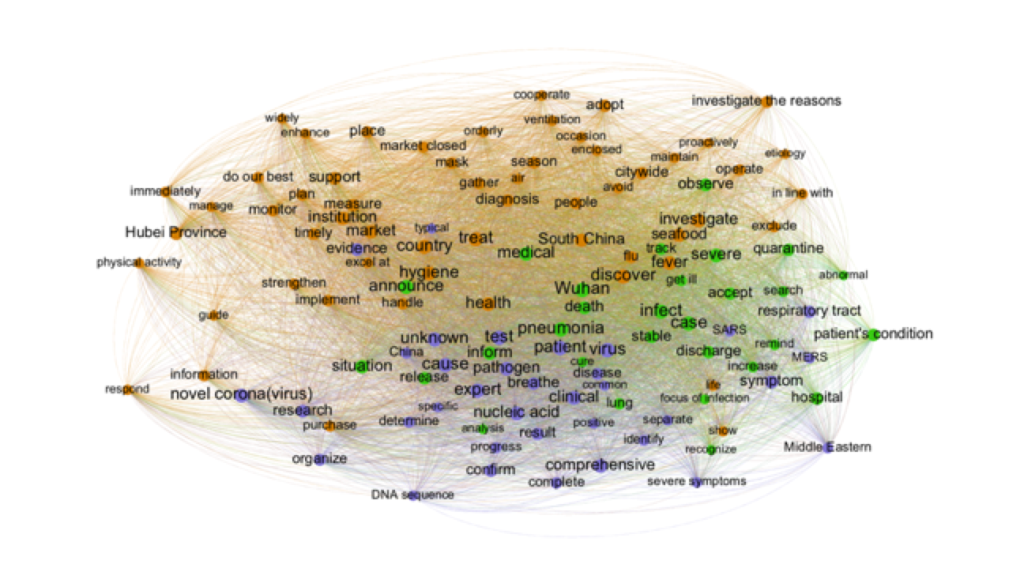
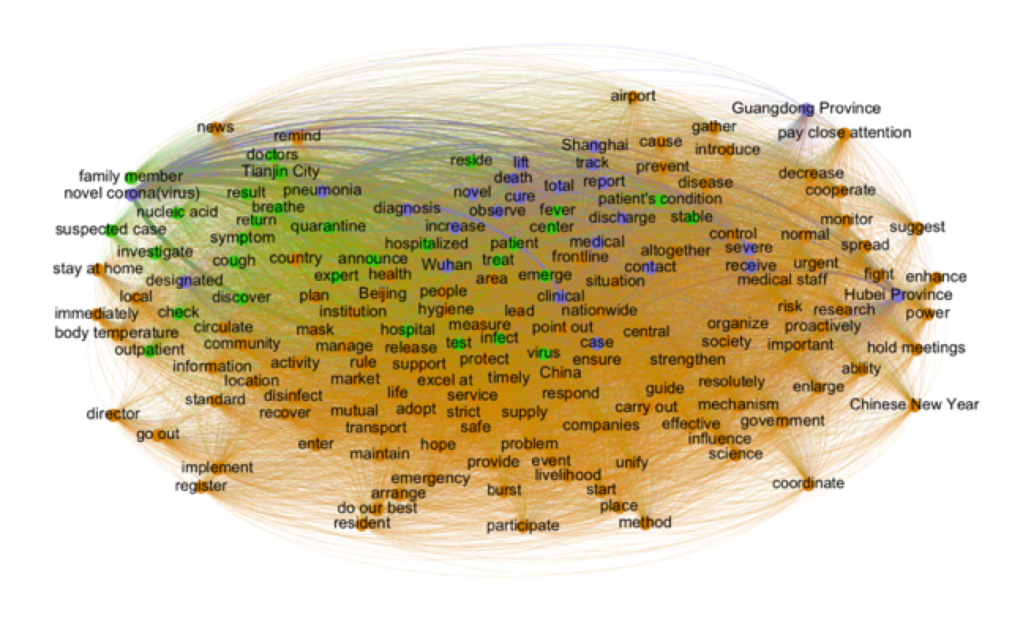
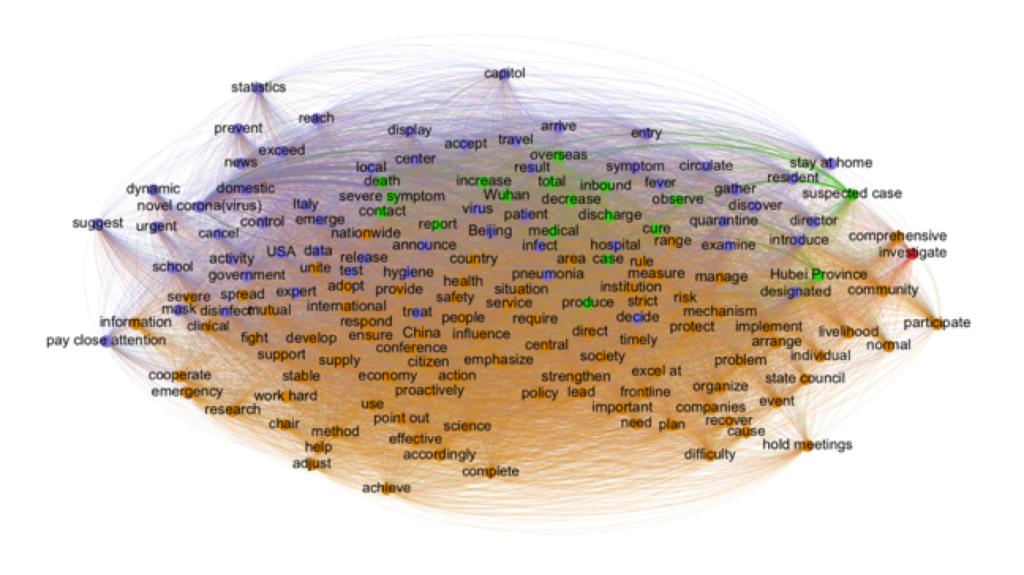
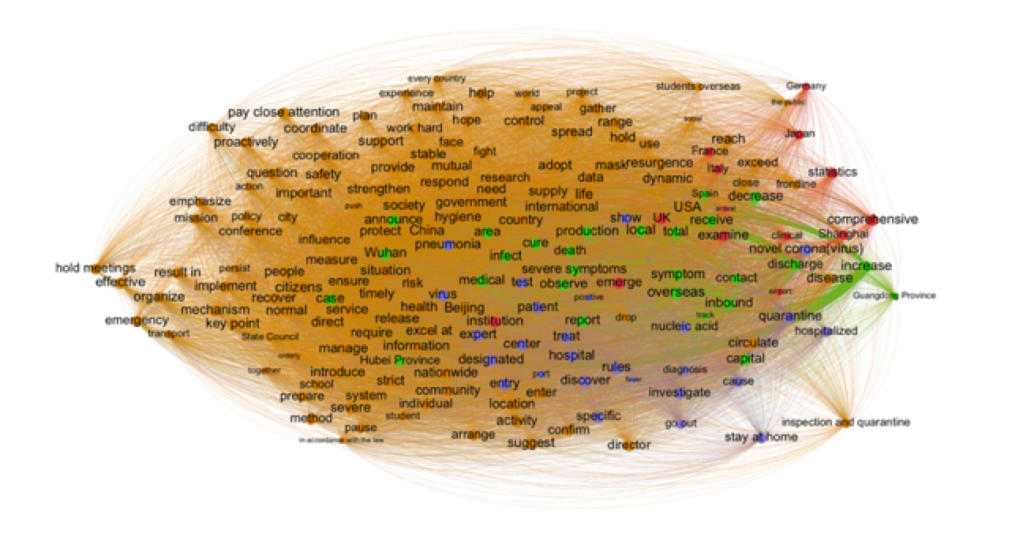
Semantic networks were extracted from posts during each stage of the outbreak, and clusters of nodes representing communication themes were identified, including investigations of the coronavirus, governmental policies and response efforts, case updates, prevention and control, and medical treatment. These themes indicate the use of information and bolstering strategies to maintain and increase government legitimacy.

Semantic Network of Top Three State Media Sina Weibo Messages about COVID-19 (Stage 1): Themes: (1) the government’s response efforts (gold), (2) expert investigations of a virus of unknown cause (purple), and (3) medical treatment (green).
Stage 2: Themes: (1) the government’s policies and response efforts (gold), (2) case updates (purple), and (3) medical treatment (green).
Stage 3: Themes (1) the government’s response efforts (gold), (2) report of inbound cases from overseas (green), (3) virus containment and report of global cases (purple), and (4) investigations of prison cases (red).

Stage 4: Themes (1) international collaboration and reopening (gold), (2) report of inbound cases from overseas (green), (3) global case updates and prevention (red), and (4) treatment (purple).

Meadows, C.Z., Tang, L., Zou, W. (2022). Managing government legitimacy during the COVID-19 pandemic in China: a semantic network analysis of state-run media Sina Weibo posts. Chinese Journal of Communication. https://doi.org/10.1080/17544750.2021.2016876 [Full text]

Are HPV vaccine interventions targeting racial and ethnic minorities doing a good job?

Image by vectorjuice on Freepik

Racial and ethnic minorities in the United States face higher risks of human papillomavirus (HPV) and are less likely to benefit from HPV vaccines. Effective HPV vaccine promotion efforts need to acknowledge and adapt to the cultural characteristics of these minority groups. 

We conducted a systematic review of all the published journal articles between 2010 and 2019 and found 26 studies reporting HPV vaccine intervention among minority populations. We further analyzed these studies to see whether and how they incorporated cultural adaptation in their interventions. Here are some of main findings:

  1. Almost all of these interventions involved some cultural adaptation. (Yeah!)
  2. Very often the adaptations were quite superficial, including community outreach and involvement or delivering the intervention in a location or through a venue convenient to the community.
  3. There is a lack of theoretically driven intervention or cultural adaptation.  Only 6 out of 26 studies mentioned behavioral or communication theories in guiding the intervention. Even though many of these studies discussed the concepts of social behavioral theories, such as efficacy, beliefs and attitudes, the majority of the researchers did not use theories to guide the design of the interventions and merely measured the aforementioned theoretical concepts as outcome variables. Consequently, it was difficult for the authors to explain why the intervention was successful or unsuccessful in creating significant improvements in the outcome variables.

Overall, we call for more comprehensive and better-designed cultural adaptations.

Zhang, X. & Tang, L. (2021). Cultural adaptation in HPV vaccine intervention among racial and ethnic minority populations: A systematic literature review. Health Education Research. Published online first. https://doi.org/10.1093/her/cyab034 [Full Text]

How middle-aged and older African American individuals use information during the COVID-19 pandemic

I have always been interested in studying the health and healthcare experiences of minority groups. Thanks to my collaborators and recently, my doctoral advisee Felicia York, I was able to study the health experiences of middle-aged and older African American individuals in terms of chronic cardiovascular disease management and information use during COVID-19.

In a study recently published in Frontiers in Public Health, we reported the findings of an interview study exploring how middle aged and older African Americans use information during the early months of the COVID-19 pandemic. Here are some of our main findings:

  1. Even at the beginning of the pandemic, these individuals primarily relied on information scanning based on their routine media consumption to acquire information about COVID-19 and seldom actively searched for information outside of their regular media use.
  2. Unlike previous studies that suggest increased social media use for information seeking and exchanging among other demographic groups [e.g., (18)], our findings show that middle[1]aged and older African Americans are less likely to use social media for COVID-19 related information.
  3. Individuals used several strategies to assess the quality of the information they received, including checking source credibility, comparing multiple sources, fact-checking, and praying.

Our study finds that middle-aged and older African American individuals overwhelmingly rely on cable news (CNN) and local television stations (ABC, CBS, and NBC) for COVID-19 related information, and they have high trust in these sources. This means that traditional TV channels are probably the most effective way to reach this particular demographic group in terms of risk communication about the COVID-19 pandemic and other public health crises in the future. For the demographic group studied in the current study, knowledge deficiency is probably not a contributing factor to the disparity related to COVID-19. In particular, since religion plays an essential role in African American’s coping with this health risk, health organizations could integrate faith-based content into health messages to attract this group’s attention.

Tang, L., York, F., & Zou, W. (2021). Information use during COVID-19: An interview study of African Americans. Frontiers in Public Health, 9:709416. https://doi.org/10.3389/fpubh.2021.709416

Male Crossdressing Performances and Gender Stereotypes in China

The remarkable success of China’s market economy, its burgeoning social media platforms, traditional beliefs about gender roles, and the government’s promotion of a harmonious society and positive energy (zheng nengliang) have given birth to a new form of comedy on Douyin: male cross-dressing videos.

Click here to see a compilation of such videos on YouTube.

However, this new genre is different from online satire videos popular during the first decade of the 21st century. Early satirical videos circulated on the Internet were inherently political and represented a subtle resistance toward Internet control and social injustice. However, in the recent decade, the political has been replaced by the personal, and resistance has given way to the embracement of the ideologies of patriarchy, commercialization, and therapeutic governance.

We studied the portrayal of female roles in male cross-dressing performances on Douyin, China’s preeminent video sharing platform. We focused on the female roles in three interpersonal relationships: mother-son/daughter relationships, heterosexual romantic relationships, and friendships.

Our analysis identified four stereotypical female personalities: fragile, controlling, materialistic, and insincere. These female personalities reflect the deeply ingrained sexism in Chinese society. Women are viewed as inferior to men and are disciplined to conform to gendered roles prescribed by traditional social norms.

Read the full text of the article here

Tang, X., Zou, W., Hu, Z., Tang, L. (2021). Recreating gender stereotypes: Male cross-dressing performances on Douyin in neo/non-liberal China. Journal of Broadcasting & Electronic Media, 65(6): 660-678(Corresponding author) https://doi.org/10.1080/08838151.2021.1955888 [Full Text]

The Stigmatization of Suicide

Image by wirestock on Freepik

Suicide is the leading cause of death among people between 14 and 35 years in China. The suicide rate of adolescents in China is 1.5 times higher than the world average, with 16.1% of Chinese adolescents ranged from 10-19 years reporting suicide ideation and 2.94% reporting suicide attempts in the last year. Among college students, 10.7% reported suicidal ideation, and 2.8% reported suicidal attempts. The suicide rate of the 14–35-year-old group in rural areas is twice that in cities.

Suicide stigma is a mark or stereotype associated with suicide. For example, people with suicidal ideation/behaviors are sometimes seen as attention-seeking or “crazy”. Suicide stigma leads to prejudice and discrimination and is a significant barrier to effective suicide prevention since such stigma hinders people’s help-seeking behaviors.

We studied how suicide stigma is communicatively constructed by examining the stories told by college students in China. Here are some of the main findings:

  • Our participants portray those who attempt or die by suicide as “familiar strangers” through the practice of othering. Participants believe that those who have suicidal ideation/behaviors are fundamentally different from themselves in terms of personality and circumstances. People who attempt or die of suicide are usually described as irresponsible, fragile, impulsive, or attention-seeking.
  • Taking one’s own life is mostly framed as a betrayal of one’s parents and family.
  • Finally, subtle differences in the suicide stigma of people of different ages and gender were also revealed. Women’s suicides are less likely to be taken seriously.

Zou, W., Tang, L., & Bie, B. (2022) The stigmatization of suicide: A study of stories told by college students in China. Death Studies, 46(9): 2035-2045. https://doi.org/10.1080/07481187.2021.1958396 [Full Text]

‘Picture me heart disease free’: understanding African Americans’ cardiovascular disease experiences through a culture-centered approach

African Americans have a disproportionately high risk of premature death caused by cardiovascular diseases (CVDs) and related risk factors such as hypertension, high cholesterol, diabetes, and obesity.

In this study, my advisee Felicia and I used the photovoice method. Participants took pictures for a period of time about how they live with CVDs and then are were interviewed about these pictures. We asked them what each of their pictures was about, why they were important, what these pictures say about their lived experiences with CVD. Photovoice is a super interesting research method that allows participants, especially members of the marginalized group, to voice their view of the world and their experiences. Very often a picture is worth a thousand words.

Here are a couple of pictures.

This study was informed by the culture-centered approach to communication’s (CCA), which call for community-based health solutions for marginalized populations.

Here are some of the findings of the study:

Participants demonstrate tremendous agency in their efforts to adopt a healthy lifestyle and manage their heart diseases. Structural factors such as socioeconomic status, insurance, discrimination, and knowledge enable and constrain their agency. Several cultural factors, such as food culture, reluctance to see doctors, consumerism, and religiosity, mediate the relationship between structure and agency. Public health professionals and researchers can capitalize on our findings in promoting cardiovascular health among the African American communities.

York, F. & Tang, L. (2021). “Picture me heart disease free”: Understand the cardiovascular disease experiences of African Americans through a culture-centered approach. Journal of Applied Communication Research. (Published online first.) https://doi.org/10.1080/00909882.2021.1912377

Studying Texas Public Health Agencies’ Twitter Messages about COVID-19 using Natural Language Processing

Texas represents a unique case among all the states in the US in dealing with COVID-19. It was among the first states to reopen in the Spring of 2020 as well as 2021. State and local governmental offices sued each other over COVID-19 control measures.

In this collaborative study involving authors from four universities in Texas (Texas A&M, University of Houston, UT Health, and Rice), we examined the Twitter message sent by all the public health agencies and emergence management organizations in Texas during the first six months of 2020. We used BERT, a natural language processing tool developed by google, to automatically classify these tweets in terms of their functions, prevention behaviors mentioned, health beliefs discussed. We also explored the relationship between tweet contents and public engagement (in term of likes and retweets).

Here are some of our findings:
• Information was the most prominent function, followed by action and community.
• Susceptibility, severity, and benefits were the most frequently covered health beliefs.
• Tweets serving the information or action functions were more likely to be retweeted, while tweets performing the action and community functions were more likely to be liked. Tweets communicating susceptibility information led to most public engagement in terms of both retweeting and liking.


Tang, L., Liu, W., Thomas, B., Tran, M., Zou, W., Zhang, X., & Zhi, D. (In press). Texas public agencies’ tweets and public engagement during the COVID-19 Pandemic: Natural language processing approach. Journal of Medical Internet Research: Public Health and Surveillance. [Preprint here]

Gay men’s wife and LGBTQ communication in China

While working on the previous study about how gay men in China come out, I learned about the existence of gay men’s wife. Around 13.6 million heterosexual women in China are married to gay or bisexual men, and they call themselves tongqi 同妻. Tongqi belong to both co-cultural groups (as women and wives) and a dominant group (as heterosexuals).

Through a narrative analysis of 51 stories told by tongqi, this study examines how tongqi make sense of their husbands’ communication behaviors and the co-cultural strategies tongqi use.

The study identifies two novel co-cultural strategies: self-blaming and enduring. Self-blaming means that co-cultural group members blame themselves for their situations. Enduring (or ren) refers to the practice of putting up with the oppression from the dominant group without protest for an extended period of time.

It also examines how tongqi narratively construct their husbands’ co-cultural strategies and finds that tongqi often internalize the ideologies (of gender, sexual orientation, marriage, and family) in their sensemaking process and in their communicative responses to their husbands.

Tang, L., Meadows, C.Z., & Li, H. (2020). How gay men’s wives in China practice co-cultural communication: Culture, identity, and sensemaking. Journal of International and Intercultural Communication, 13(1), 13-31. doi: 10.1080/17513057.2019.1569252 [Full article]