Semantic Network of China’s State-Run Media’s Weibo posts during the COVID-19 pandemic

China’s state-run media are the mouthpiece of the government. During public health crises such as the COVID-19 pandemic, they are responsible for disseminating essential information to the public on behalf of the government. This study examined the Sina Weibo posts published by three leading state-run media entities (CCTV, People’s Daily, and Xinhua News Agency) during the first wave of the COVID-19 outbreak.

Semantic networks were extracted from posts during each stage of the outbreak, and clusters of nodes representing communication themes were identified, including investigations of the coronavirus, governmental policies and response efforts, case updates, prevention and control, and medical treatment. These themes indicate the use of information and bolstering strategies to maintain and increase government legitimacy.
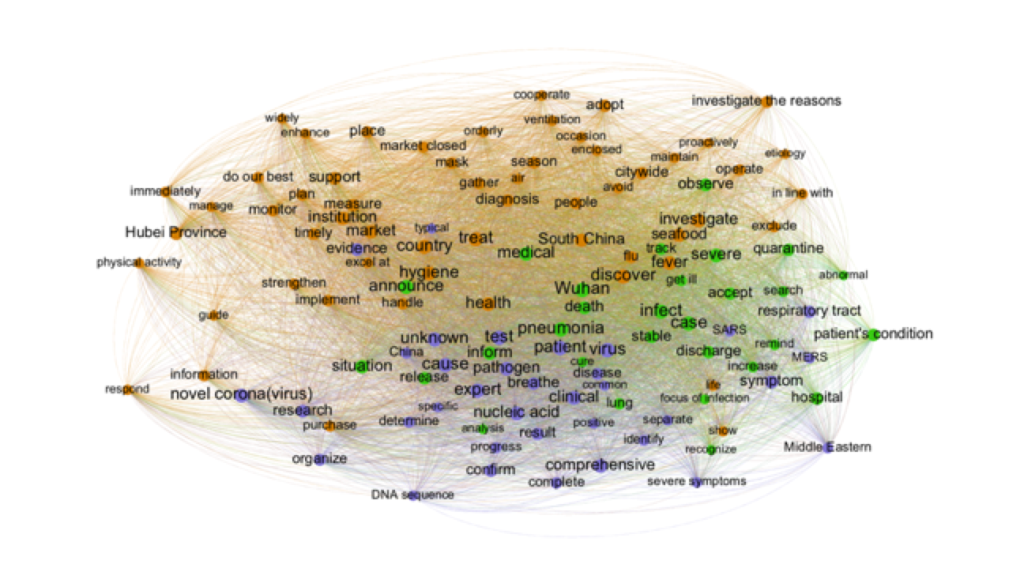
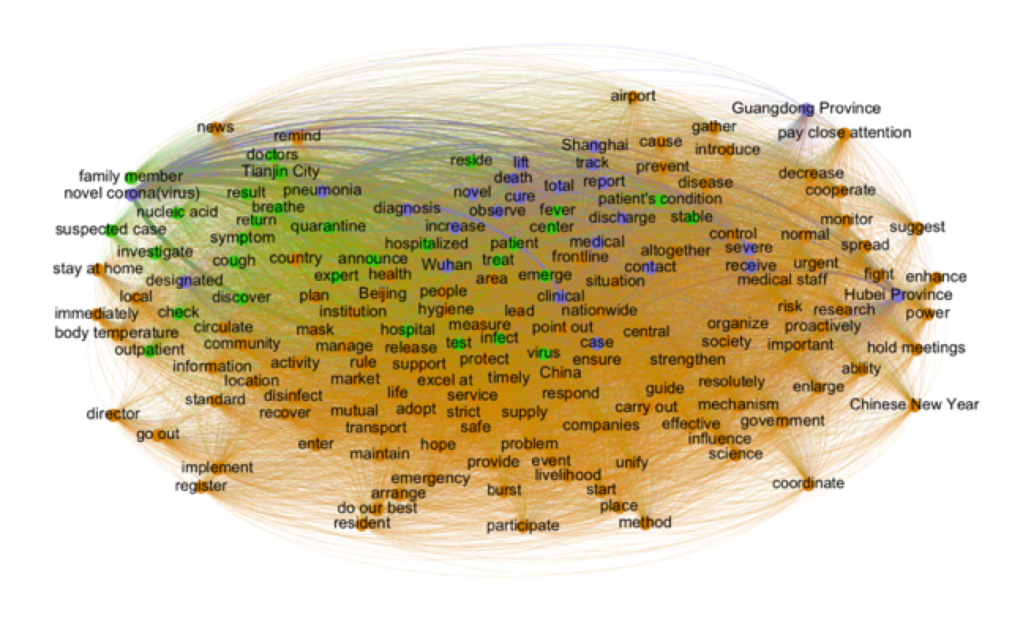
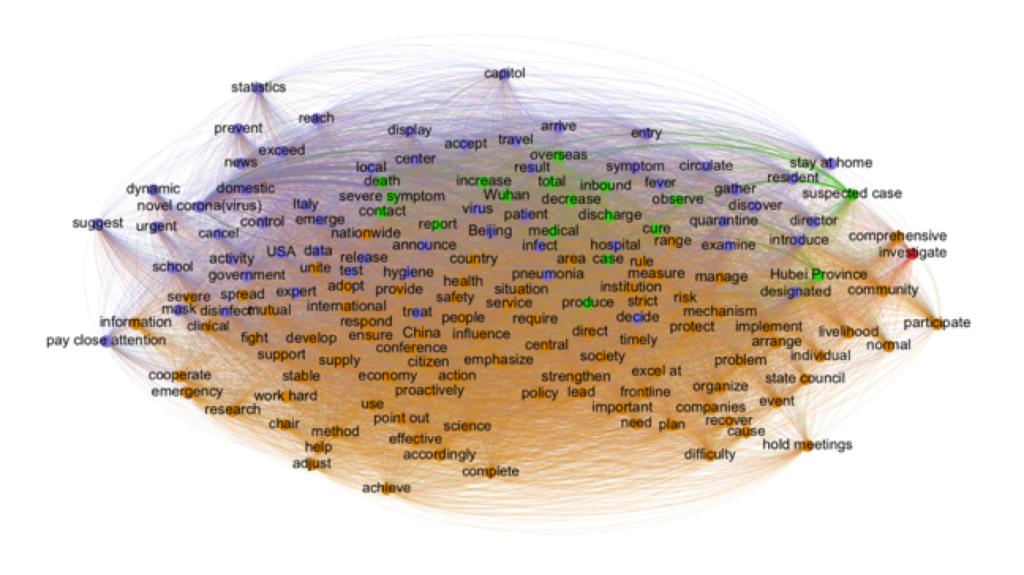
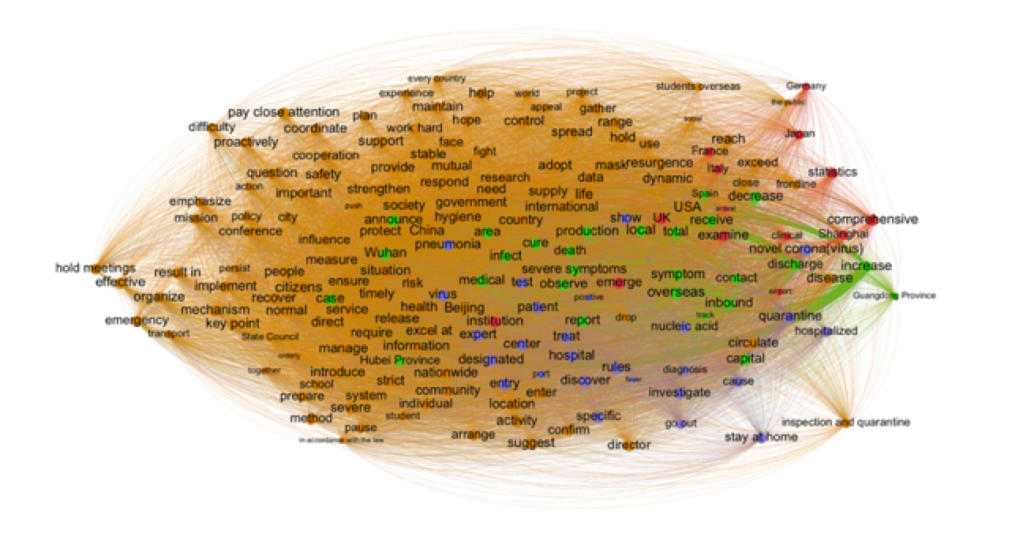
Semantic Network of Top Three State Media Sina Weibo Messages about COVID-19 (Stage 1): Themes: (1) the government’s response efforts (gold), (2) expert investigations of a virus of unknown cause (purple), and (3) medical treatment (green).
Stage 2: Themes: (1) the government’s policies and response efforts (gold), (2) case updates (purple), and (3) medical treatment (green).
Stage 3: Themes (1) the government’s response efforts (gold), (2) report of inbound cases from overseas (green), (3) virus containment and report of global cases (purple), and (4) investigations of prison cases (red).

Stage 4: Themes (1) international collaboration and reopening (gold), (2) report of inbound cases from overseas (green), (3) global case updates and prevention (red), and (4) treatment (purple).

Meadows, C.Z., Tang, L., Zou, W. (2022). Managing government legitimacy during the COVID-19 pandemic in China: a semantic network analysis of state-run media Sina Weibo posts. Chinese Journal of Communication. https://doi.org/10.1080/17544750.2021.2016876 [Full text]
Studying Texas Public Health Agencies’ Twitter Messages about COVID-19 using Natural Language Processing

Texas represents a unique case among all the states in the US in dealing with COVID-19. It was among the first states to reopen in the Spring of 2020 as well as 2021. State and local governmental offices sued each other over COVID-19 control measures.

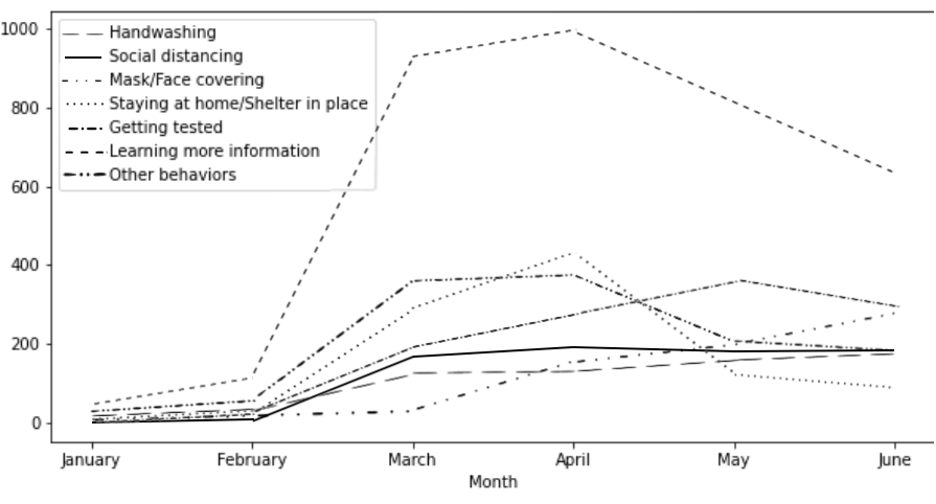
In this collaborative study involving authors from four universities in Texas (Texas A&M, University of Houston, UT Health, and Rice), we examined the Twitter message sent by all the public health agencies and emergence management organizations in Texas during the first six months of 2020. We used BERT, a natural language processing tool developed by google, to automatically classify these tweets in terms of their functions, prevention behaviors mentioned, health beliefs discussed. We also explored the relationship between tweet contents and public engagement (in term of likes and retweets).

Here are some of our findings:
• Information was the most prominent function, followed by action and community.
• Susceptibility, severity, and benefits were the most frequently covered health beliefs.
• Tweets serving the information or action functions were more likely to be retweeted, while tweets performing the action and community functions were more likely to be liked. Tweets communicating susceptibility information led to most public engagement in terms of both retweeting and liking.


Tang, L., Liu, W., Thomas, B., Tran, M., Zou, W., Zhang, X., & Zhi, D. (In press). Texas public agencies’ tweets and public engagement during the COVID-19 Pandemic: Natural language processing approach. Journal of Medical Internet Research: Public Health and Surveillance. [Preprint here]