Exploring the Early Adoption of Open AI among Laypeople and Technical Professionals: An Analysis of Twitter Conversations on #ChatGPT and #GPT3

Large language models (LLMs) such as GPT-3 and their derivative products such as ChatGPT have garnered significant attention for their remarkable ability to process texts and conduct human-like conversations.

Guided by the Diffusion of Innovation theory, this study examines the early discussions about LLMs on Twitter, specifically about ChatGPT and GPT-3, during the first three months following the release of ChatGPT. By utilizing topic structural modeling and sentiment analysis on a sample of 42,273 #ChatGPT tweets and 17,639 #GPT3 tweets, we explore how laypeople and technical professionals differ in their attitudes in the early stage of the adoption of LLMs.

Here are some of the main findings:

  • Overall, the discussion of #GPT3 is more positive and the discussion of #ChatGPT is more negative.
  • The discussion surrounding ChatGPT and GPT-3 primarily revolves around relative advantage and compatibility.
  • The Twitter discussion using #ChatGPT is highly business-oriented, while the discussion of #GPT3 covers a broader range of topics in terms of the characteristics, applications, and potential ethical concerns of LLMs.

Topics Discussed in #ChatGPT Tweets

NumberTopic LabelHigh-Probability WordsExample Tweet
1User feedbackask, like, know, write, think, one, tri, time, peopl, joke“My single advice to #ChatGPT is that it should just say ‘I don’t know’ for things it doesn’t know or is not very sure of. Spitting out convincing-looking nonsense is the worst thing that can greatly harm people who rely on it.”
2Online games (advertisement)tech, machinelearn, token, chat, python, robot, game, coin, web, artificialintellig“Play https://t.co/7AV9V1Ghfp #mmorpg #space #starwars #eve #fortnite #startrek #AI #dalle #COD #cs #ChatGPT #pubg  #pc #nintendo #ps5 #ps4 #aiart #art #mmo #trippy #nft #fantasy #RPG #minecraft #vr #ar #xbox”
3Cryptocurrency investment (advertisement)launch, futur, crypto, nft, part, invest, eth, readi, airdrop, join“Ready to join the revolution? Invest in #ChatGPT coin today and be a part of the decentralized future of money! #web3 https://t.co/hlgW5f4eJm
4Stocks and trading (advertisement)openai, googl, artificialintellig, chatbot, check, bard, free, resum, trade, power“Take a look to $BANR #investments #daytrading #investing #YOLO #news #ToTheMoon #RedditArmy #StocksToWatch  #trading #StocksToBuy #options #Stocks #bottomfishing #ChatGPT https://t.co/fKuSatAvw1
5AI application in search engines and artmicrosoft, search, bing, openai, midjourney, dall, engin, project, new, art“Chinese Search Giant Baidu to Launch #ChatGPT-Style Bot #Baidu, known as #China’s #Google, will embed it in search engine. Tech giants in the US and China are in a race to adopt #AI https://t.co/15O7p1TtpL
6Strategies for content creationuse, help, creat, generat, tool, content, make, code, market, busi“Write website copy: #ChatGPT can be used to generate unique, high-quality #websites copy, including product descriptions, #landingpage, and more. You could offer this service to businesses looking to improve the quality of their #websites content.”
7Blockchain (advertisement)resum, altcoin, generat, bot, web, impress, crypto, nfts, xgem, cryptocurr“@xFloGems $FLUX #Flux #poUW #FLUXUSDT #AI #FluxNodes #CloudComputing #Cloud #Web3  #Mining #Kadena #Decentralization #ChatGPT #GameFi #cryptocurrency #altcoins #cryptomarket #BUIDLing”
8Writing promptsprompt, chat, thank, job, interest, share, feel, list, first, tweet“Prompt for copywriting https://t.co/YYV3DwcBG4 #chatgpt #chatgptprompts #chatbot #chatbotai #aichatbot #ai #artificialintelligence #aiprompts #prompts #writingprompts #ideaprompts #creativeprompts”
9Education and AIanswer, question, learn, model, languag, educ, use, student, read, data“@driderk @CollinRugg As a language model, it can generate human-like responses to a wide range of inputs, but it’s not capable of conducting independent research or providing original reporting. It’s not a substitute for traditional teaching. #ChatGPT #AI”
10AI future and innovationsworld, futur, technolog, next, new, live, big, innov, mind, excit“Are you afraid of the AI future? Listen to the dystopian voices of ChatGPT on the mini concept album ‘AI – The Rise’ (7 Min). It will blow your mind! https://t.co/TUfLcj9Qub #OpenAI #ChatGPT #AIArtwork #aiartcommunity #bandcamp https://t.co/EJTZUo2Sch”

Topics Discussed in #GPT3 Tweets

NumberTopic LabelHigh-Probability WordsExample Tweet
1Adoption of OpenAIuse, openai, generat, chat, write, creat, tool, new, code, get“Build WhatsApp bot using Meta Cloud APIs – Check GPT3 API integration with WhatsApp – Build an awesome use case for this integration – GPT3 powered travel assistant, check it out! https://t.co/WuK9GbHXNJ #WhatsApp #gpt3 #metaapi #OpenAI”
2AI biasinput, output, race, avoid, medrxiv, internet, bias, engin, phenotyp, artificialintellig“Input will bias output; like with humans. The question is, was the input data subjective, or is it representative of the ideas on the internet. The former is bias of the engineers. The later is bias of the loudest Internet complainers. #ai #GPT3 #bias #BigTech @Cernovich”
3Use of AI in virtual assistants or chatbotsopenai, free, support, pleas, ranklinmediaau, tweetbot, virtual, wish, assistant, happi“Wish you all a blessed year ahead! May your days be filled with joy and success. Eid Mubarak and Happy New Yearfrom everyone at Virtual AI assistant. #NYE #HappyNewYear #franklinmediaau #tweetbot #gpt3 #openai”
4AI application in arthelp, art, better, need, also, midjourney, follow, like, space, softwar“An old men image created by AI #stablediffusion #AIArtwork #AI #midjourney #OpenAI #dalle #gpt3 #art #promptengineering”
5AI-powered multimedia creation services (advertisement)dall, imag, generat, text, audio, uniqu, awesom, use, work, aitextgener“Generate Awesome unique images, text, Audio using AI #AIart #aiartcommunity #MultipleWords #AI #Text #Image #Audio #Generator #AIImageGenerator #AITextGenerator #AIAudioGenerator #StableDiffusion #GPT3 #DALLE https://t.co/NSvtF3yL9s”
6Trading (advertisement)prompt, data, trade, built, train, one, model, new, larg, leverag“@MyMetaTrader is The next-gen lev trading built on @Arbitrum leverage – multiple assets one single vault $MMT with #GPT3 Trade smarter, not harder with high very less supply ..and strong project $MMT #MyMetaTrader @MyMetaTrader Join fast #MyMetaTrader”
7Biomedical researchhaiku, stablediffus, sar, cell, cov, protein, memori, genet, cancer, genom“Imagine an AI/LLM that ingested and trained on the worlds data, similar to #GPT3 and the coming #GPT4 including all of the worlds scholarly studies with raw data, structured data and summaries. Areas such as: Education, Climate, Genetics & IQ, Social Issues, Biotech Research. How scary the academia would be.”
8AI-generated storieslike, time, one, know, look, make, thing, get, think, said“@gyzkard, she always pulls her sweater over her head, and then she takes off without a word. I try to explain that I’m sorry but it doesn’t work because the moment she opens the door, someone will get up there and push me back down onto my bed! Created by #gpt3”
9Exploring the AI technology landscapelanguag, model, learn, technolog, artificialintellig, chatbot, futur, machinelearn, nlp, busi“Exploring the #AI technology landscape: From #MachineLearning to natural language processing. AI is revolutionizing the way we interact with #technology. #TechTrends #Python #GPT3 #AITrend #AITransformation #DEVCommunity #100DaysOfCode #Digital #NeuralNetworks #IoT #nlp”
10Comparing human and GPT-3 performancehuman, mani, research, import, may, system, found, inform, nerdjok, paper“2/2 Researchers compared the performance of human reasoners and GPT-3 on various analogical reasoning tests and found that in most cases, GPT-3 was able to match or even surpass humans capabilities for abstract pattern induction #GPT3 #GPT4 #AI”

Zou, W., Li, J., Yang, Y., & Tang, L. (2023). Exploring the early adoption of Open AI among laypeople and technical professionals: An analysis of Twitter conversations on ChatGPT and GPT-3. International Journal of Human-Computer Interaction. DOI: 10.1080/10447318.2023.2295725 [Full text]
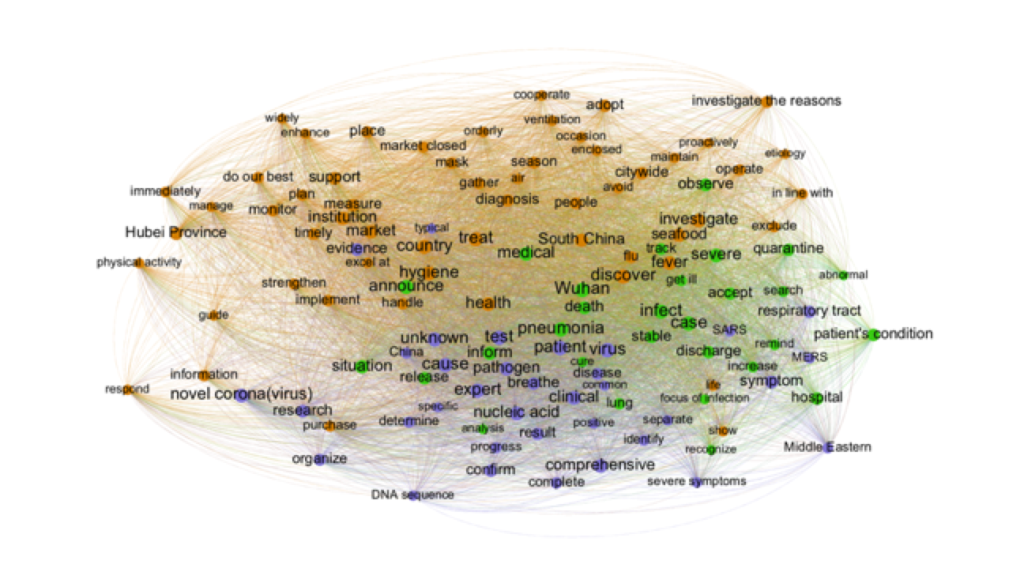
Semantic Network of China’s State-Run Media’s Weibo posts during the COVID-19 pandemic

China’s state-run media are the mouthpiece of the government. During public health crises such as the COVID-19 pandemic, they are responsible for disseminating essential information to the public on behalf of the government. This study examined the Sina Weibo posts published by three leading state-run media entities (CCTV, People’s Daily, and Xinhua News Agency) during the first wave of the COVID-19 outbreak.

Semantic networks were extracted from posts during each stage of the outbreak, and clusters of nodes representing communication themes were identified, including investigations of the coronavirus, governmental policies and response efforts, case updates, prevention and control, and medical treatment. These themes indicate the use of information and bolstering strategies to maintain and increase government legitimacy.

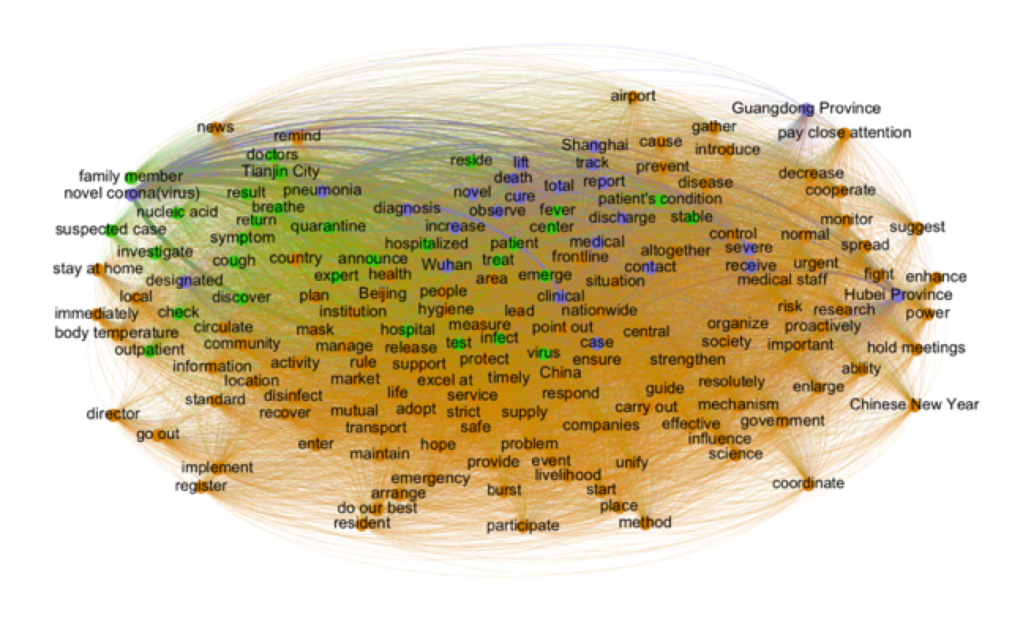
Semantic Network of Top Three State Media Sina Weibo Messages about COVID-19 (Stage 1): Themes: (1) the government’s response efforts (gold), (2) expert investigations of a virus of unknown cause (purple), and (3) medical treatment (green).
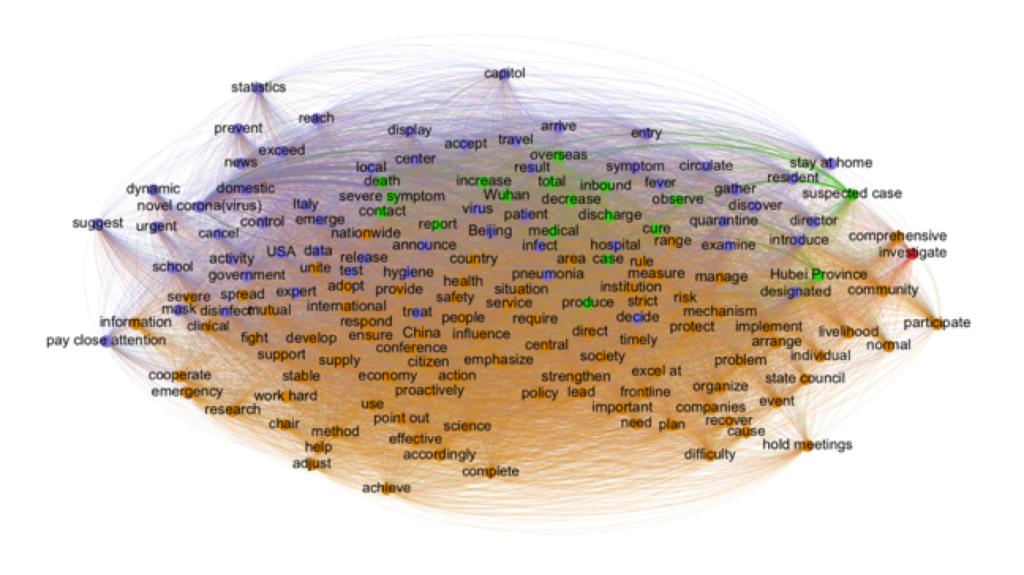
Stage 2: Themes: (1) the government’s policies and response efforts (gold), (2) case updates (purple), and (3) medical treatment (green).
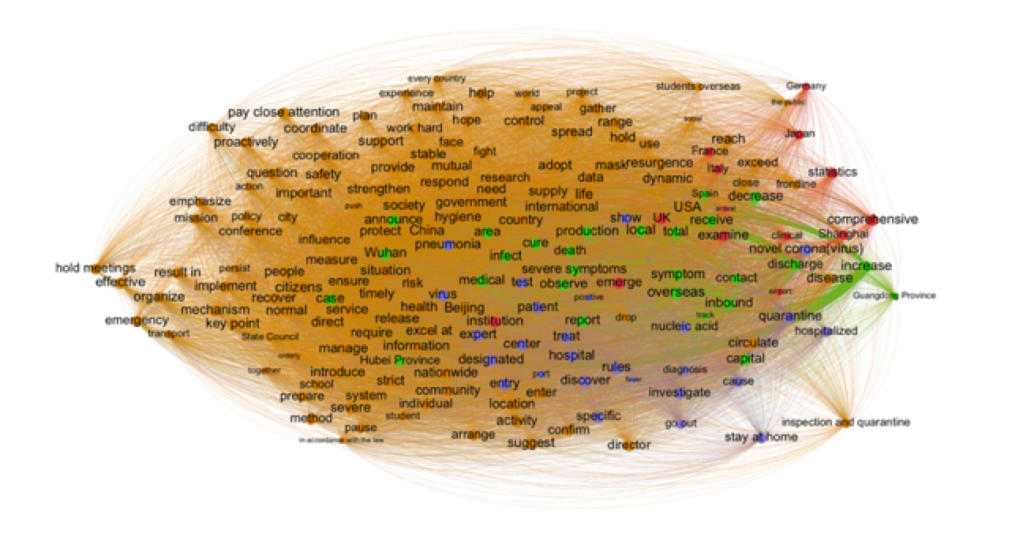
Stage 3: Themes (1) the government’s response efforts (gold), (2) report of inbound cases from overseas (green), (3) virus containment and report of global cases (purple), and (4) investigations of prison cases (red).

Stage 4: Themes (1) international collaboration and reopening (gold), (2) report of inbound cases from overseas (green), (3) global case updates and prevention (red), and (4) treatment (purple).

Meadows, C.Z., Tang, L., Zou, W. (2022). Managing government legitimacy during the COVID-19 pandemic in China: a semantic network analysis of state-run media Sina Weibo posts. Chinese Journal of Communication. https://doi.org/10.1080/17544750.2021.2016876 [Full text]

Male Crossdressing Performances and Gender Stereotypes in China

The remarkable success of China’s market economy, its burgeoning social media platforms, traditional beliefs about gender roles, and the government’s promotion of a harmonious society and positive energy (zheng nengliang) have given birth to a new form of comedy on Douyin: male cross-dressing videos.

Click here to see a compilation of such videos on YouTube.

However, this new genre is different from online satire videos popular during the first decade of the 21st century. Early satirical videos circulated on the Internet were inherently political and represented a subtle resistance toward Internet control and social injustice. However, in the recent decade, the political has been replaced by the personal, and resistance has given way to the embracement of the ideologies of patriarchy, commercialization, and therapeutic governance.

We studied the portrayal of female roles in male cross-dressing performances on Douyin, China’s preeminent video sharing platform. We focused on the female roles in three interpersonal relationships: mother-son/daughter relationships, heterosexual romantic relationships, and friendships.

Our analysis identified four stereotypical female personalities: fragile, controlling, materialistic, and insincere. These female personalities reflect the deeply ingrained sexism in Chinese society. Women are viewed as inferior to men and are disciplined to conform to gendered roles prescribed by traditional social norms.

Read the full text of the article here

Tang, X., Zou, W., Hu, Z., Tang, L. (2021). Recreating gender stereotypes: Male cross-dressing performances on Douyin in neo/non-liberal China. Journal of Broadcasting & Electronic Media, 65(6): 660-678(Corresponding author) https://doi.org/10.1080/08838151.2021.1955888 [Full Text]

Studying Texas Public Health Agencies’ Twitter Messages about COVID-19 using Natural Language Processing

Texas represents a unique case among all the states in the US in dealing with COVID-19. It was among the first states to reopen in the Spring of 2020 as well as 2021. State and local governmental offices sued each other over COVID-19 control measures.

In this collaborative study involving authors from four universities in Texas (Texas A&M, University of Houston, UT Health, and Rice), we examined the Twitter message sent by all the public health agencies and emergence management organizations in Texas during the first six months of 2020. We used BERT, a natural language processing tool developed by google, to automatically classify these tweets in terms of their functions, prevention behaviors mentioned, health beliefs discussed. We also explored the relationship between tweet contents and public engagement (in term of likes and retweets).

Here are some of our findings:
• Information was the most prominent function, followed by action and community.
• Susceptibility, severity, and benefits were the most frequently covered health beliefs.
• Tweets serving the information or action functions were more likely to be retweeted, while tweets performing the action and community functions were more likely to be liked. Tweets communicating susceptibility information led to most public engagement in terms of both retweeting and liking.


Tang, L., Liu, W., Thomas, B., Tran, M., Zou, W., Zhang, X., & Zhi, D. (In press). Texas public agencies’ tweets and public engagement during the COVID-19 Pandemic: Natural language processing approach. Journal of Medical Internet Research: Public Health and Surveillance. [Preprint here]

Doctor Patient Communication in China II

This study examines the doctor-patient communication in China through the perspective of patients. Patient satisfaction is an important intermediate outcome of patient-provider encounters, linking face-to-face interactions between patients and medical professionals with patients’ well-being after consultations.

Today, physician review websites provide a new venue for the study of patient satisfaction, as patients are utilizing such websites to evaluate their encounters with physicians. This study examined how parents of pediatric patients in China evaluated their pediatricians and factors associated with patient satisfaction through a qualitative content analysis of reviews (n = 7230) on the “Good Doctor Website” (haodf.com), China’s largest physician review platform.

Three dimensions of patient satisfaction were identified:

  1. pediatricians’ interpersonal manners (including friendliness, listening to patients, heartfelt encouragement, and clear explanation)
  2. ethics (including rejecting red envelopes and kickbacks and cost awareness)
  3. medical competence/overall health outcome.

This study contributes to a culturally sensitive understanding of patient satisfaction and further explains the tense physician-patient relationship in China. Practically, our findings can inform the training of pediatricians in China.

Wu, Q. & Tang, L. (2021). What satisfies parents of pediatric patients in China: A grounded theory building analysis of online doctor’s reviews. Health Communication. https://doi.org/10.1080/10410236.2021.1888437 [Read full text here]

What do Sina Weibo influencers say about health?

Social media health influencers are a new type of opinion leaders in the era of Web 2.0. Health influencers are social media influencers who focus on health-related topics. They capitalize on social media platforms for educational, financial, or political purposes. But what do they say about health?

We studied the contents of top 10 health influencers of Sina Weibo, a Chinese microblogging site equivalent to Twitter boasting over 462 million users. Here are some findings:

  • Health influencers had a clear emphasis on women’s health (OB/GYN diseases and risks related to pregnancy and childcare) and beauty and skincare (in terms of risks and benefits).
  • Overall, they used low fear appeal and high efficacy messages. However, messages containing efficacy information were less likely to be liked.
  • These influencers relied heavily on narrative evidence; however, there was no significant relationship between the use of either narrative or statistical evidence and the number of likes.

Zou, W., Zhang, W.J., & Tang, L. (2021). What do social media influencers say about health? A theory-driven content analysis of top ten health influencers on Sina Weibo. Journal of Health Communication. 10.1080/10810730.2020.1865486 [Read the full text here]

Mickey Mouse got the measles!

Do you remember the 2015 Measles outbreak originating in Disneyland in California? This outbreak was one of the biggest outbreaks of emerging infectious diseases in the United States before the COVID-19 pandemic.

In one study, we examined the semantic networks of Twitter contents about measles based on the corpus of 1 million tweets.

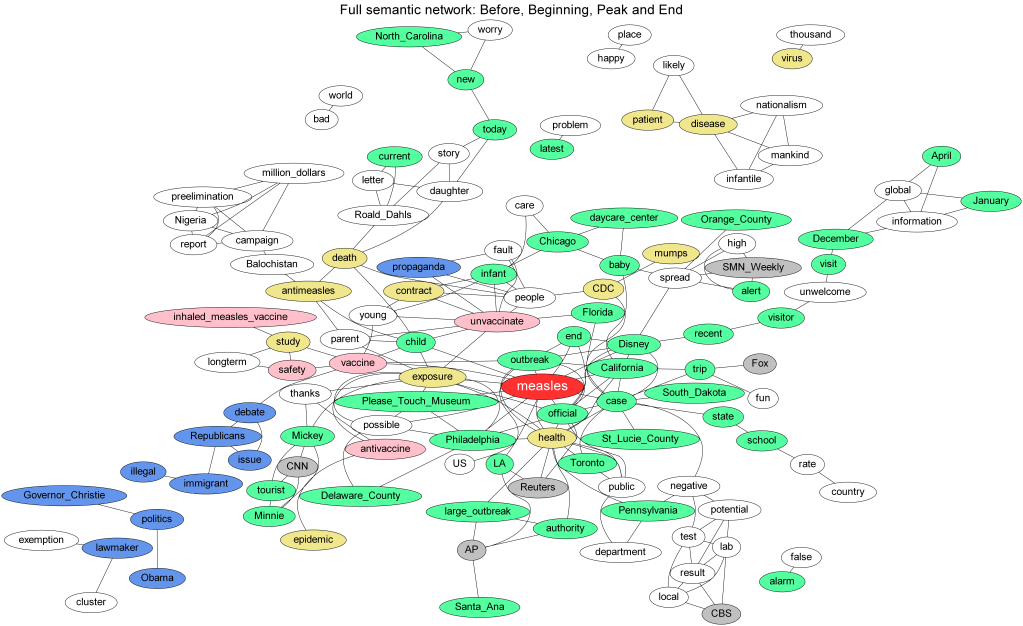
Semantic networks represent the semantic relationships among a set of words. In a semantic network, word-use frequencies and co-occurrence of the most frequently occurring words represent shared meanings and common perceptions. For instance, the cluster of purple words in the lower-left corner of the network represents the political frame, where people talk about the causes and solutions of the outbreak in political terms. For instance, whether measles was brought to the US by immigrant? What kind of role the government should play in preventing such outbreaks?

We identified four major frames: news update frame, public health frame, vaccine frame, and political frame.  

We also mapped the longitudinal changes of the frames during different stages of the outbreak.

The news update frame appeared to be the most dominant frame during the initial and resolution stages.

The public health frame was 1 of the 2 most dominant frames in the pre- crisis stage; however, its use decreased during the initial stage and was lowest during the maintenance stage.

The use of the vaccine frame increased from pre-crisis stage to the initial stage and the vaccine frame became the most dominant frame during the maintenance.

The political frame was the least often used frame in all four stages of the outbreak and appeared most frequently during the maintenance stage.

Tang, L., Bie, B., Zhi, D. (2018). Tweeting about measles during an outbreak: A semantic network approach to the framing of emerging infectious diseases. American Journal of Infection Control, 46(12), 1375-1380. doi: 10.1016/j.ajic.2018.05.019

The way we use YouTube influences our chance of getting vaccine misinformation.

Have you wondered how you stumbled upon that anti-vaccine video on YouTube? How come one innocent click of the video might or might not lead you to an avalanche of more videos that not only tell you that vaccine causes autism but also try to sell you vitamins and magical herbs?

Recently, I completed a study that examined how user behavior and YouTube’s ranking and recommendation algorithms influence the exposure to different kinds of vaccine information.

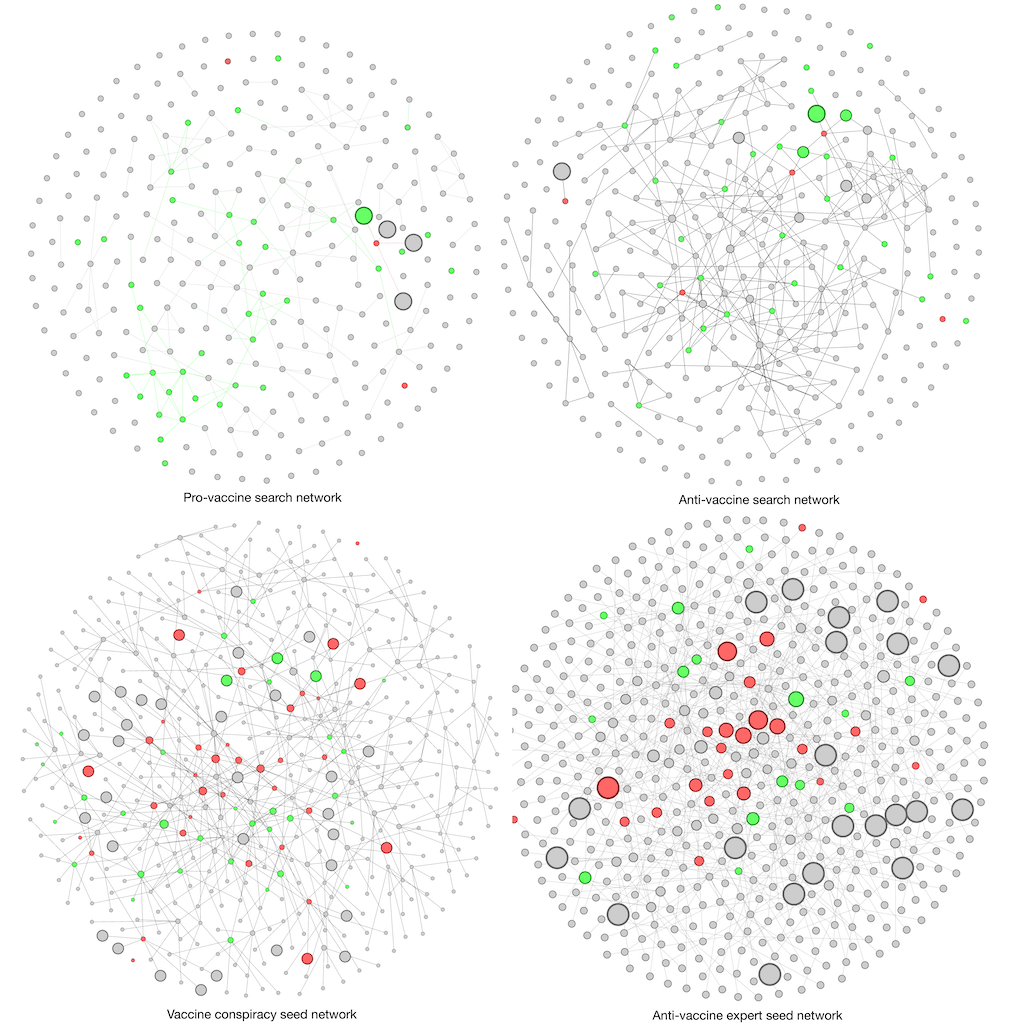
We explored the different patterns of exposure on YouTube when a person starts with a keyword-based search on the YouTube platform (goal-oriented browsing) and when a person starts with an anti-vaccine video on another website such as Facebook (direct navigation). We simulated the patterns of exposure by creating four networks of videos based on YouTube recommendations.

First, we created two search networks, one from a set of pro-vaccine keywords and the other from a set of anti-vaccine keywords. For each network, we collected the first six videos, and for each of these six videos, we further collected six recommended videos, and another six videos for this second layer of videos. Videos collected based on pro-vaccine keywords and anti-vaccine keywords are then put into separate networks. The same procedure was used to create two additional networks starting from two sets of anti-vaccine seed videos. (In the four networks below, green dots represent pro-vaccine videos, red dots represent anti-vaccine videos, and gray dots represent non-vaccine videos.)

What we found was that viewers are more likely to encounter anti-vaccine videos through direct navigation starting from an anti-vaccine seed video (the two networks on the bottom) than through goal-oriented browsing (the two networks on the top).

Why is it the case?

I think it is because YouTube is intentionally suppressing the rankings of anti-vaccine videos in its search research. So you are unlikely to find anti-vaccine video even if you start with some anti-vaccine keywords. However, when you start with an anti-vaccine seed video that you encounter from another platform, such as Facebook, reddit, or your crazy uncle’s email, the protection mechanism YouTube doesn’t work anymore. When you click one anti-vaccine video, YouTube’s recommendation algorithm will show more and more anti-vaccine videos. This is also called the “filter bubble,”

Tang, L., Fujimoto, K., Amith, M., Cunningham, R., Costantini, R.A., York, F., Xiang, G., Boom, J., & Tao, C. (2020). Going down the rabbit hole? An exploration of network exposure to vaccine misinformation on YouTube. Journal of Medical Internet Research. doi: 10.2196/23262