Do you remember the 2015 Measles outbreak originating in Disneyland in California? This outbreak was one of the biggest outbreaks of emerging infectious diseases in the United States before the COVID-19 pandemic.
In one study, we examined the semantic networks of Twitter contents about measles based on the corpus of 1 million tweets.
Semantic networks represent the semantic relationships among a set of words. In a semantic network, word-use frequencies and co-occurrence of the most frequently occurring words represent shared meanings and common perceptions. For instance, the cluster of purple words in the lower-left corner of the network represents the political frame, where people talk about the causes and solutions of the outbreak in political terms. For instance, whether measles was brought to the US by immigrant? What kind of role the government should play in preventing such outbreaks?
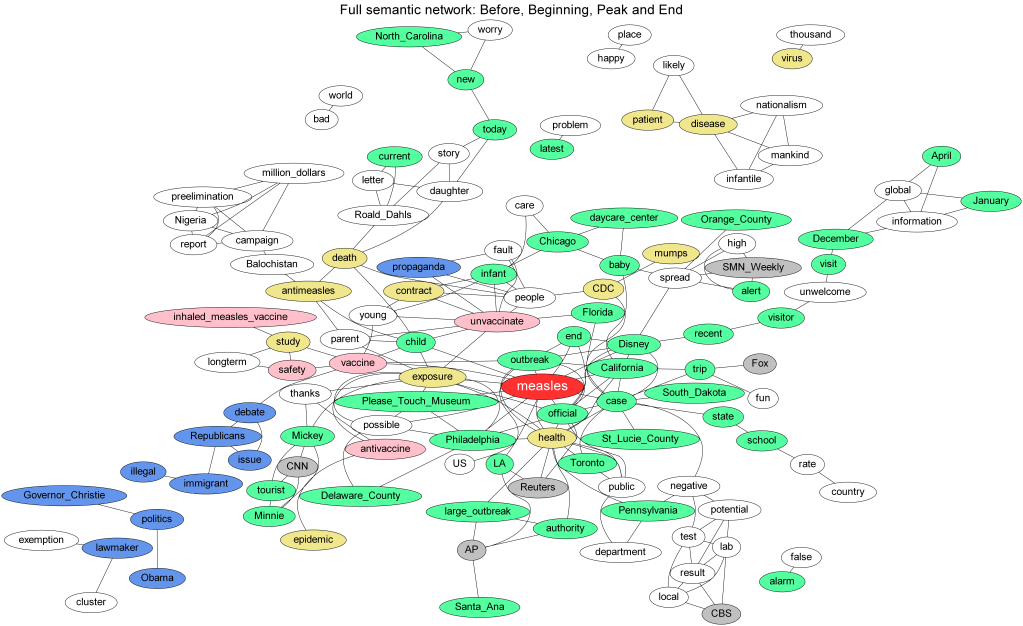
We identified four major frames: news update frame, public health frame, vaccine frame, and political frame.
We also mapped the longitudinal changes of the frames during different stages of the outbreak.
The news update frame appeared to be the most dominant frame during the initial and resolution stages.
The public health frame was 1 of the 2 most dominant frames in the pre- crisis stage; however, its use decreased during the initial stage and was lowest during the maintenance stage.
The use of the vaccine frame increased from pre-crisis stage to the initial stage and the vaccine frame became the most dominant frame during the maintenance.
The political frame was the least often used frame in all four stages of the outbreak and appeared most frequently during the maintenance stage.

Tang, L., Bie, B., Zhi, D. (2018). Tweeting about measles during an outbreak: A semantic network approach to the framing of emerging infectious diseases. American Journal of Infection Control, 46(12), 1375-1380. doi: 10.1016/j.ajic.2018.05.019
 Dr. Lu Tang, Health Communication Researcher